TOOTH REMOVAL
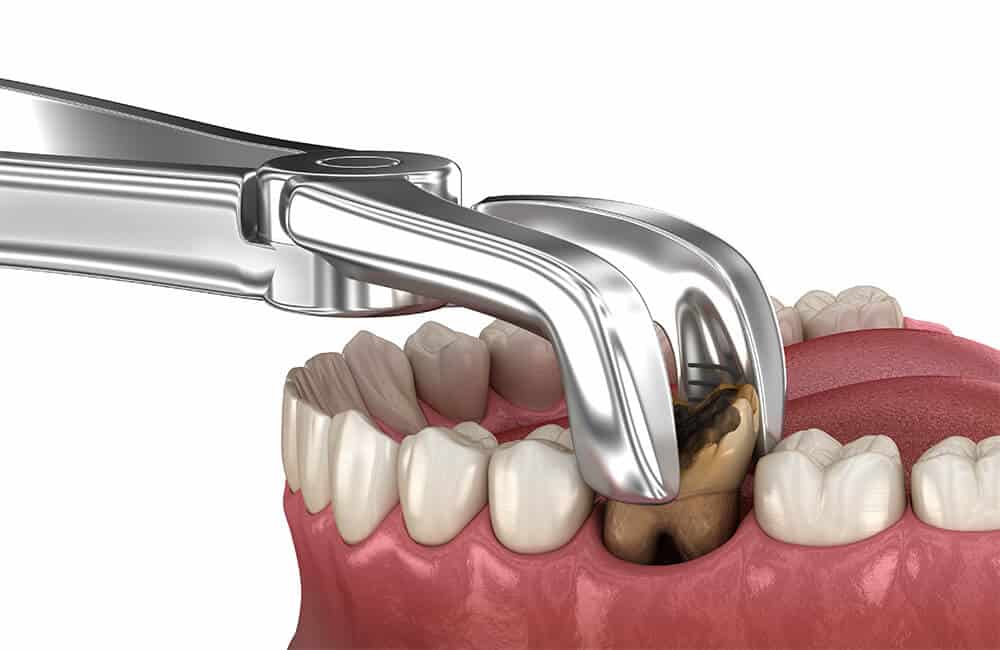
Advances in dental technology means we dentists can save more teeth than ever before. However, when decay or damage is severe or the jaw is overcrowded, removing the tooth may be the only solution.
The extraction process is normally quick and straightforward. A local anaesthetic is applied to thoroughly numb the tooth and surrounding area – we also offer sedation if you feel particularly nervous or anxious. During the procedure you will feel some pressure, but it won’t be painful. Following the extraction we will advise you on aftercare to ensure your mouth heals quickly.
If you’re unhappy with a gap in your teeth we offer a range of natural-looking alternatives, including bridges and implants, to replace the missing tooth.
SIMPLE EXTRACTIONS

How is the extraction done?
The procedure is very simple and requires only one session. For the extraction of a damaged tooth, local anesthesia must be performed. It may happen that during the operation the patient feels some annoying noise or the pressure exerted by the dentist's instruments, but all this is foreseeable and apart from this the pain is normally excluded. However, if this does not happen it means that not all the nerves have been anesthetized, in which case the patient must ask the dentist to stop the operation and repeat the anesthesia. Sometimes the tooth has to be divided into two or three in order to be able to extract it. This prevents the smallest parts of the same from remaining in the gum and thus causing inflammation and swelling. Following this practice the tooth is extracted without any problem.
WISDOM TEETH EXTRACTION

Problems with wisdom teeth
Wisdom teeth are located at the bottom of the dental arch and are also called third molars. They are the last teeth to erupt and usually do so around 18-25 years old.
When they are not in the right position or when they do not have enough space to be able to erupt, they could only partially do so by creating a space where bacteria can accumulate. If these areas are not cleaned properly they can become infected.
The symptoms of wisdom tooth inflammation are various:
- Facial swelling
- Pain in the mouth or jaw
- Difficulty opening your mouth
Wisdom teeth extraction
Usually wisdom tooth extraction is performed when the area is not inflamed. If your face is swollen and the wisdom tooth area is very painful, the dentist may only perform a checkup. It is also possible that a panoramic X-ray is necessary and an antibiotic may be caught in it to decrease inflammation and be able to postpone the extraction until the area is less inflamed.
- If the tooth is completely erupted, it is usually removed by the dentist. Treatment is usually quick and is done under local anesthesia.
- If the wisdom tooth is growing in the wrong direction or is not completely erupted, the extraction will be more complex and will be performed by the surgeon. Also in this case the extraction will be done under local anesthesia, in some cases it will however be necessary to divide the tooth into several parts and stitches may be applied.
What to do after a wisdom tooth extraction
After the extraction of the wisdom tooth, attention must be paid to the extraction area. Here are some rabbits for a quick recovery:
- Do not clean, rinse or spit on the day of extraction
- Clean the extraction area from the third day with a soft brush
- Do not consume alcohol for the 3 days following the extraction
- Avoid large physical forces and sports
- Avoid hot, spicy or crunchy foods for a week